An engineering guide to building scalable, cost-aware voice AI agents, originally published in 2025 and revised in 2026.
Revision note (22 July 2026): Provider prices and model status in the selection tables were refreshed. WER, ELO, TTFT, and throughput figures explicitly labeled historical remain a May 2025 snapshot, not current guarantees. All cost examples below state their assumptions and exclude taxes, add-ons, free tiers, negotiated terms, and infrastructure unless noted.
Executive Summary
Production voice systems require careful choices around endpointing, streaming, context management, provider modes, observability, and failure handling. The historical benchmarks in this guide are retained for context; current implementation decisions should use workload-specific measurements and the source-linked 2026 pricing tables.
Table of Contents
- Understanding the Cost Structure
- Component Selection Strategy
- Production Architecture Patterns
- Cost Optimization Techniques
- Scaling and Enterprise Considerations
- Worked List-Price Cost Scenarios
- Illustrative Implementation Roadmap
Understanding the Cost Structure
Voice AI systems typically comprise four main cost components, each with different scaling characteristics:
Cost drivers by component
There is no reliable universal percentage split: a quiet inbound line, a verbose assistant, a reasoning-heavy workflow, and a self-hosted stack can have completely different profiles.
| Component | Primary billing inputs | Important qualifiers |
|---|---|---|
| Speech-to-Text (STT) | Audio or connected-session duration | Streaming vs pre-recorded mode, request minimums, rounding, channels, add-ons |
| Large Language Model (LLM) | Input, output, cached, and sometimes reasoning tokens | Context policy, cache reads/writes, long-context tiers, tool calls |
| Text-to-Speech (TTS) | Characters, text/audio tokens, credits, or runtime | Billable-character rules, plan utilization, voice multipliers |
| Infrastructure/Hosting | Compute time, concurrency, network, storage, telephony | Region, utilization, redundancy, observability, committed capacity |
The Context Growth Problem
With uninterrupted full-history resend, LLM input accumulates across turns. The production calculator divides total speech between the user and assistant, rounds the number of turns, and uses:
total_words = words_per_min × conversation_length
assistant_tokens = total_words × assistant_speech_ratio × tokens_per_word
user_tokens = total_words × (1 - assistant_speech_ratio) × tokens_per_word
turns = max(1, round(turns_per_min × conversation_length))

Input Tokens = user_tokens × (turns + 1) / 2
             + assistant_tokens × (turns - 1) / 2
             + fixed_input_tokens_per_request × turns
This is a conservative scenario, not an unavoidable growth law. Rolling context, summaries, retrieval, prompt caching, or starting a new session can materially change token usage. Measure token counts from actual requests instead of extrapolating a universal multiplier between short and long calls.
Component Selection Strategy
Speech-to-Text: Performance vs Cost Analysis
Based on independent benchmarks analyzing accuracy, speed, and pricing:
| Provider | Model | Historical WER | Historical latency | Current price used | Qualifier |
|---|---|---|---|---|---|
| OpenAI | GPT-4o Transcribe | 8.9% | ~320ms | Token-billed; no fixed minute price | Historical benchmark only |
| Deepgram | Nova-3 monolingual pre-recorded | 12.8% | <300ms | $0.0077/min | Streaming is a separate promotional $0.0048/min row |
| AssemblyAI | Universal-2 pre-recorded | 8.6% | ~300ms | $0.0025/min | Add-ons and mode can change price |
| Groq | Whisper Large V3 Turbo synchronous | 12.0% | <300ms | $0.0006667/min | Ten-second request minimum |
| Gladia | Solaria-3 async Starter | ~6% | ~270ms | $0.0101667/min | Current model/price; old benchmark |
Recommendation: Benchmark current candidates on your audio, mode, region, language, and add-ons; there is no universal best cost/performance choice.
Large Language Models: The Performance-Cost Matrix
Voice applications often value low measured time-to-first-token, reliable function calling, and conversational coherence. Set a latency objective from the complete voice path rather than imposing one universal LLM threshold.
Current API pricing examples
| Model | Input / output per 1M tokens | Qualifier |
|---|---|---|
| GPT-5.6 Luna | $1 / $6 | Standard API; cache and long-context tiers separate |
| Gemini 3.6 Flash | $1.50 / $7.50 | Output includes thinking tokens |
| Claude Sonnet 5 | $2 / $10 through 31 Aug 2026 | Changes to $3 / $15 on 1 Sep 2026 |
| DeepSeek V4 Flash | $0.14 / $0.28 | Cache-miss input baseline |
| Mistral Small 4 | $0.15 / $0.60 | Cache and batch discounts separate |
| Nova 2 Lite, Bedrock Global Standard | $0.30 / $2.50 | Region/profile-specific |
| Grok 4.5 | $2 / $6 | Up to 200K prompt; higher long-context tier |
Text-to-Speech: Price and lifecycle examples
The quality/speed annotations below are retained from the May 2025 benchmark snapshot; the prices and lifecycle labels were checked on 22 July 2026. The groupings are examples, not a current quality ranking.
Higher public price or subscription-derived examples
- ElevenLabs Flash v2.5: $50/1M chars; speed/ELO figures below are historical
- Cartesia Sonic 3.5: plan-derived, $50/1M effective on Pro; old score belongs to discontinued Sonic English
- OpenAI GPT-4o Mini TTS: deprecated and token-billed; no fixed character price
Lower public character-rate examples
- Azure Standard Neural: $15/1M chars; speed/ELO figures are historical
- Google WaveNet (legacy): $4/1M chars; speed/ELO figures are historical
- Amazon Polly Standard: $4/1M chars; the old 1,091 chars/s and ELO 797 measurements are historical
Recommendation: Benchmark current voices on your text, language, latency target, and plan; no one model is universally best.
Production Architecture Patterns
Pattern 1: Orchestrated Pipeline
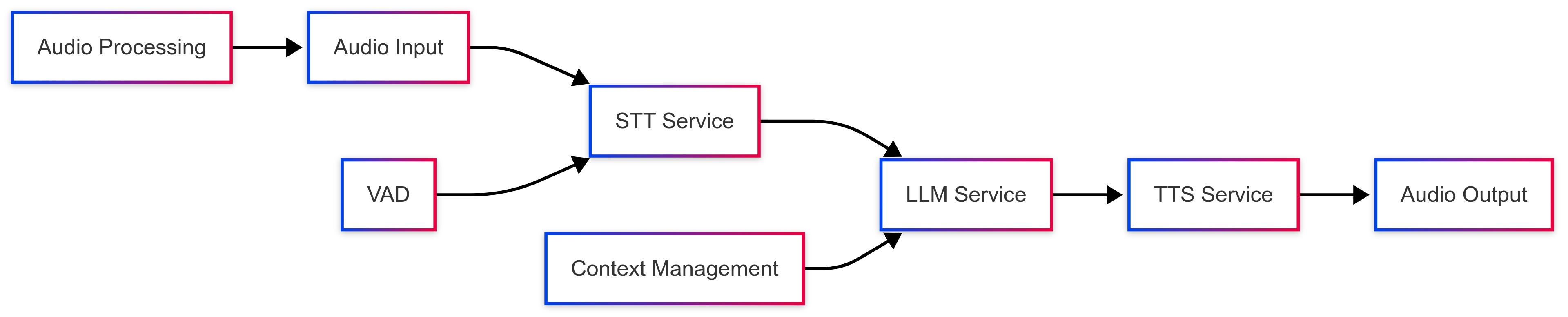
Advantages: Maximum flexibility, component optimization, vendor negotiation leverage Disadvantages: Higher complexity, multiple API dependencies Consider when: Component-level control and vendor flexibility justify the integration work
Pattern 2: Unified Platform
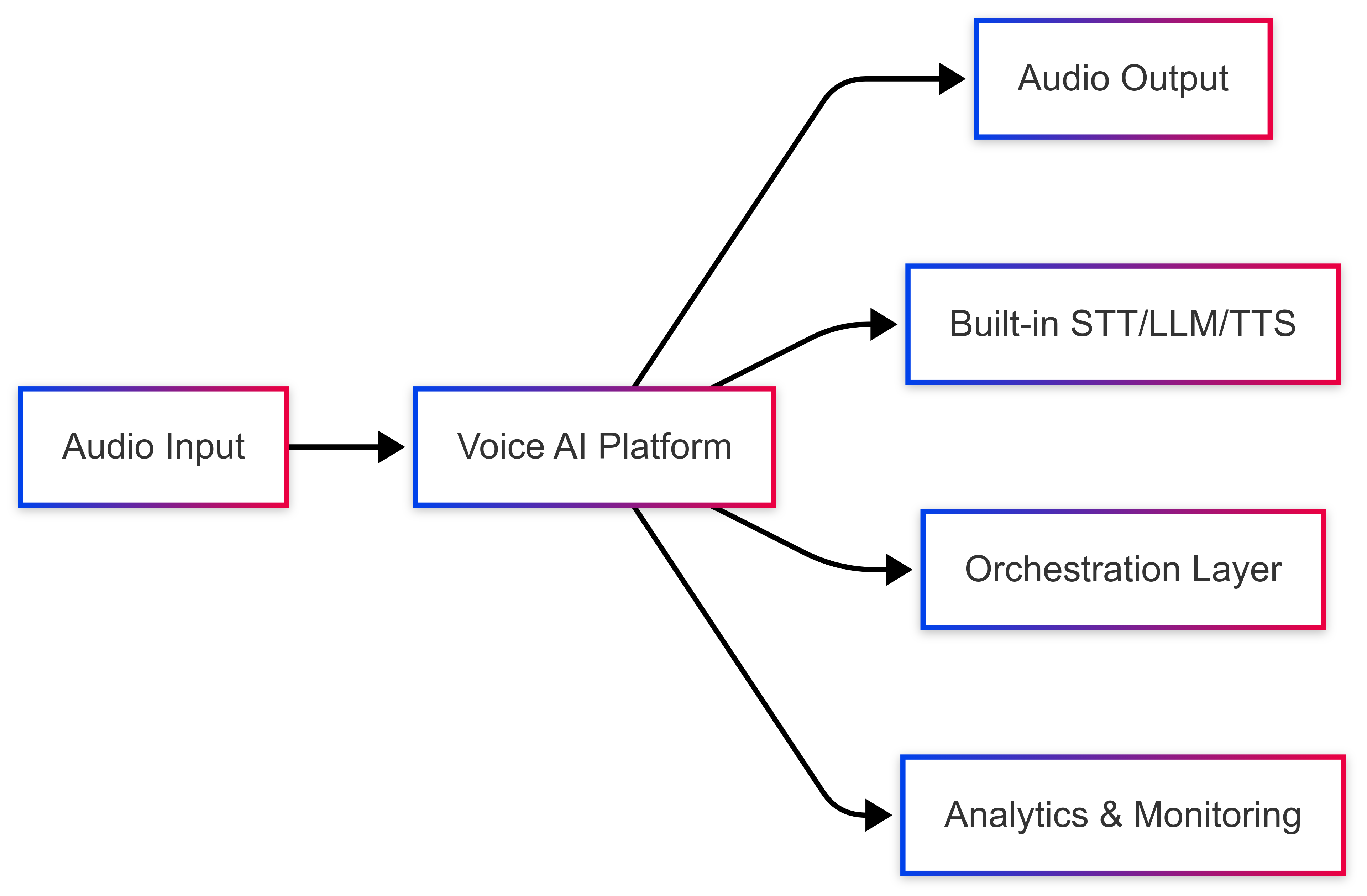
Advantages: Simplified deployment, integrated optimization, single vendor relationship Disadvantages: Vendor lock-in, limited component choice Consider when: Reduced integration work is worth the platform constraints and fees
Pattern 3: Hybrid Edge-Cloud
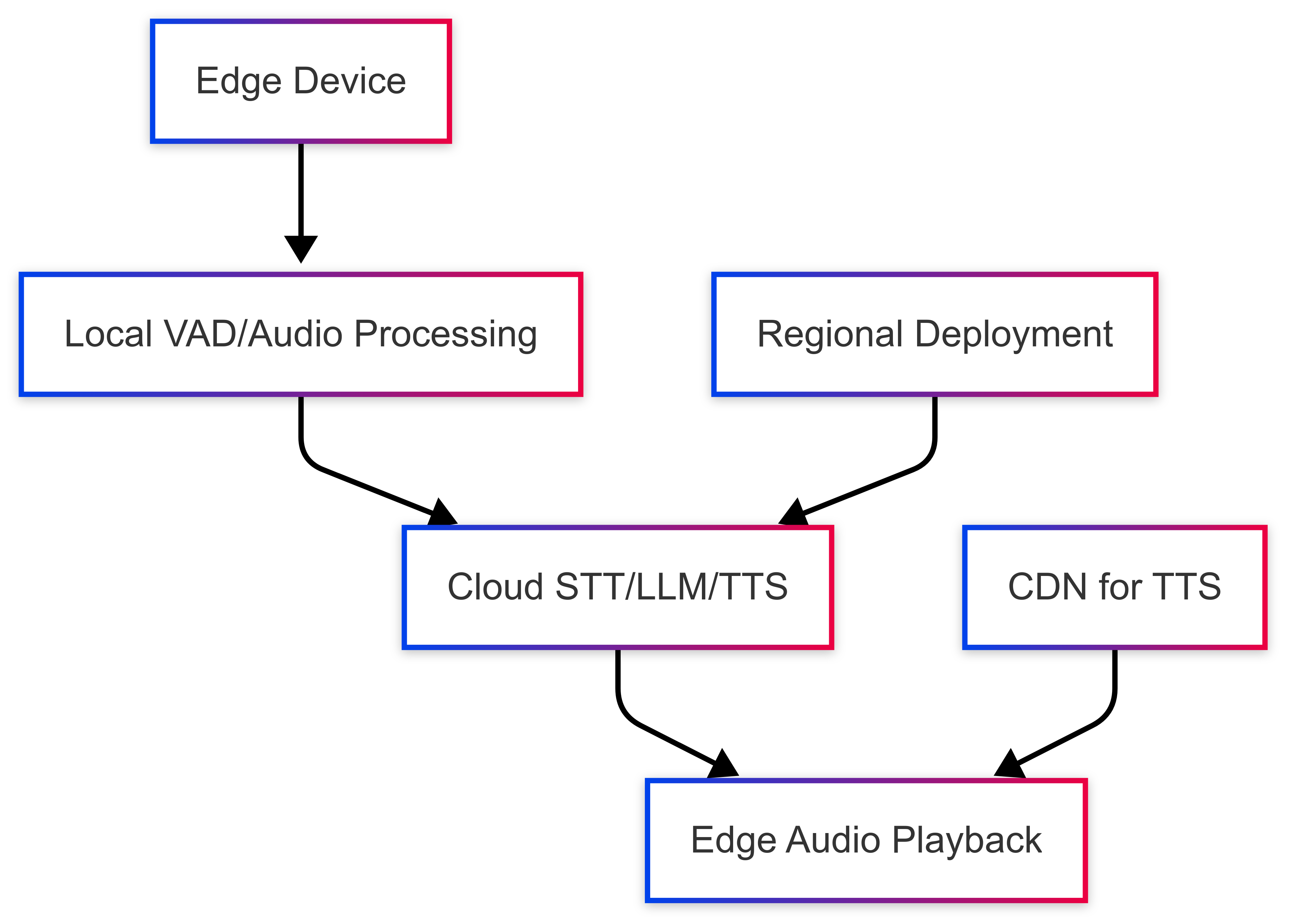
Advantages: Reduced latency, bandwidth optimization Disadvantages: Complex deployment, edge resource requirements Consider when: Measured edge benefits justify the deployment and update complexity
Cost Optimization Techniques
1. Context Management Strategies
Technique: Rolling Context Windows
def manage_context(messages, count_tokens, input_budget, summary_budget):
    """Compact a list of message objects using the target model's tokenizer."""
    if count_tokens(messages) <= input_budget:
        return messages

    recent = []
    for message in reversed(messages):
        candidate = [message, *recent]
        if count_tokens(candidate) > input_budget - summary_budget:
            break
        recent = candidate

    older = messages[: len(messages) - len(recent)]
    summary_message = {
        "role": "system",
        "content": summarize_context(
            older,
            max_output_tokens=summary_budget,
        ),
    }
    compacted = [summary_message, *recent]

    # Production code should re-summarize or trim if the actual tokenizer
    # reports that the result still exceeds the request's input budget.
    if count_tokens(compacted) > input_budget:
        raise ValueError("Compacted context exceeds the input budget")
    return compacted
Set input_budget from the selected model's current context limit after reserving room for output, tools, and fixed instructions. len(messages) is not a token count, and slicing a message list by an integer does not retain that many tokens. Replay representative conversations with and without summarization; compare billed tokens, summary-model cost, answer quality, and latency.
Technique: Semantic Caching
# Cache responses for semantically similar queries
# Replace this scenario value with a measured hit rate from your workload.
cache_hit_rate = 0.25
original_cost = llm_calls * cost_per_call
cached_cost = (
    llm_calls * (1 - cache_hit_rate) * cost_per_call
    + llm_calls * cache_hit_rate * cache_lookup_cost
)

savings = original_cost - cached_cost
Do not assume a cache hit is free. Include lookup/storage cost, invalidation, stale-answer risk, and the provider's distinction between prompt-cache reads and application-level response caching.
2. Model Tier Routing
Route queries based on complexity:
def route_query(query, context):
    complexity_score = analyze_complexity(query, context)

    if complexity_score < 0.3:
        return "economy_model"
    elif complexity_score < 0.7:
        return "general_model"
    else:
        return "reasoning_model"
Choose thresholds from evaluated examples, log the selected route, and maintain a fallback. The distribution and savings are workload-specific; calculate them from routed token counts rather than assuming a fixed 60/30/10 mix.
3. Provider-Specific Optimizations
OpenAI: Token Caching
- Pricing is model-specific: for GPT-5.6 Luna, a cache read is $0.10/M input tokens versus $1/M uncached input as of 22 July 2026, while cache writes are 1.25× the uncached input rate
- Implementation: follow provider requirements for stable prompt prefixes, then monitor actual cached-token usage; application response caching is a different mechanism
Google Gemini: Implicit Caching
- Pricing is model-specific: for Gemini 3.6 Flash, cached input is $0.15/M tokens and cache storage is $1/M tokens/hour as of 22 July 2026
- Implementation: compare the read savings with storage duration and actual reuse before enabling explicit cache storage
Anthropic Claude: Prompt Cache or Retrieval
- Use case: cache a stable repeated prefix when it is reused, or retrieve only relevant knowledge when the source set is large or changes frequently
- Evaluation: compare cache-write/read charges, retrieval cost, token volume, freshness, and answer quality; there is no universal request-count break-even
Scaling and Enterprise Considerations
Volume Pricing Negotiations
Providers do not publish one shared spend threshold or discount schedule. Ask each shortlisted provider for a quote using the same workload specification:
- monthly audio/session minutes, token volumes, generated characters, regions, and concurrency
- committed term and minimum spend
- included support, uptime commitments, data-retention terms, and add-on prices
- overage rate, unused-credit treatment, taxes, and exit provisions
Keep the public list-price scenario alongside the quote so the value and risk of a commitment remain visible.
Infrastructure Scaling Patterns
Illustrative Regional Deployment Configuration
regions:
  primary: us-east-1     # Main processing
  secondary: eu-west-1   # European users
  tertiary: ap-southeast # Asian users

latency_slos:
  # Set p50/p95 values only after measuring the complete path in each region.
  same_region: measured_value
  cross_region: measured_value

# Price compute, egress, storage, failover capacity, and managed API regions separately.
Auto-scaling Configuration
voice_agents:
  min_instances: 3
  max_instances: 100
  scale_metric: concurrent_calls
  target_utilization: 70%

models:
  gpu_instances: 2-8 per region
  model_loading_time: 30-60s
  warm_pool: 25% of max capacity
The instance counts, utilization, model-load time, and warm-pool size above are placeholders, not recommended defaults. Derive them from load tests and failure-recovery objectives.
Worked List-Price Cost Scenarios
The following is a reproducible calculator scenario, not evidence from a production deployment or a quality ranking.
Workload assumptions:
- 22,000 independent calls/month, 3 minutes each (66,000 minutes)
- 130 combined spoken words/minute, split 50% user and 50% assistant
- 1.3 tokens/word, 4 turns/minute, and 6 billable characters/word
- no fixed system/tool tokens, non-speech output tokens, cache hits, add-ons, free allowances, taxes, telephony, or infrastructure
Each call therefore has 390 spoken words, 12 turns, 3,042 accumulated LLM input tokens, 253.5 LLM output tokens, and 1,170 generated TTS characters under the calculator's full-history-resend formula.
Scenario A: current list-price components
| Component | Published rate used | Per call | Per month |
|---|---|---|---|
| Deepgram Nova-3 monolingual streaming | $0.0048/min promotional rate | $0.014400 | $316.80 |
| GPT-5.6 Luna | $1 input / $6 output per 1M tokens | $0.004563 | $100.39 |
| ElevenLabs Flash v2.5 | $50 per 1M characters | $0.058500 | $1,287.00 |
| Total, excluding infrastructure | $0.077463 | $1,704.19 | |
| Average per call minute | $0.025821 |
Scenario B: a different current list-price mix
| Component | Published rate used | Per call | Per month |
|---|---|---|---|
| AssemblyAI Universal-Streaming | $0.0025/connected session minute | $0.007500 | $165.00 |
| DeepSeek V4 Flash | $0.14 cache-miss input / $0.28 output per 1M tokens | $0.000497 | $10.93 |
| Amazon Polly Standard | $4 per 1M characters | $0.004680 | $102.96 |
| Total, excluding infrastructure | $0.012677 | $278.89 | |
| Average per call minute | $0.004226 |
These totals were calculated from public catalog rates checked on 22 July 2026. Deepgram labels the streaming rate promotional; AssemblyAI bills the connected session, including idle time; provider regions and account terms can change the invoice. The lower total in Scenario B is not a quality, language-coverage, latency, or suitability conclusion. Re-run the comparison with measured token and character counts from your own calls.
Illustrative Implementation Roadmap
The sequence and durations below are planning placeholders. Adjust them for team size, procurement, security review, integrations, and reliability requirements.
Phase 1: MVP Deployment (Weeks 1-4)
Architecture: Simple orchestrated pipeline Budget: Estimate from expected calls using public list prices, then set a hard usage alert Components:
- STT: benchmark a current streaming row such as Deepgram Flux/Nova-3 or AssemblyAI Universal-Streaming
- LLM: benchmark current supported candidates such as GPT-5.6 Luna, Gemini 3.6 Flash, or another catalog row
- TTS: use a directly billable active model for the first estimate; model subscription products separately
- Infrastructure: Single region, autoscaling
Phase 2: Production Hardening (Weeks 5-12)
Focus: Reliability, monitoring, cost optimization Additions:
- Context management system
- Semantic caching layer
- Multi-region deployment
- Comprehensive monitoring
Phase 3: Scale Optimization (Months 4-6)
Focus: Cost efficiency, performance optimization Enhancements:
- Model tier routing
- Provider negotiations
- Edge deployment (if needed)
- Advanced analytics
Phase 4: Enterprise Features (Months 7-12)
Focus: Security, compliance, advanced features Budget: Varies by requirements Features:
- SOC 2 compliance
- Custom model fine-tuning
- Advanced workflow management
- White-label deployment
Key Recommendations
For Teams Starting with a Managed Stack
- Start with a measurable baseline: choose current models that match the required mode, language, region, and billing unit
- Use managed platforms: Consider Vapi or Retell for rapid deployment
- Implement context trimming early: Critical for cost control
- Monitor billable units: Set alerts for audio/session minutes, input/output tokens, characters, and add-ons
For Teams Evaluating Enterprise Commitments
- Request comparable enterprise quotes: include commitments, overages, support, regions, and exit terms
- Evaluate caching: compare measured hit rate and quality with read/write/storage charges
- Evaluate model tier routing: validate routing quality and calculate savings from actual routed tokens
- Deploy regionally: Balance latency vs operational complexity
- Plan for measured demand: load-test expected concurrency and define a documented headroom target from traffic forecasts and failure scenarios
For Regulated Industries
- Verify compliance evidence: review the exact service, region, contract, certifications, and data-processing terms instead of inferring compliance from a provider name
- Data residency: confirm where audio, transcripts, logs, backups, and support data are processed
- Audit trails: Implement comprehensive logging
- Model transparency: Avoid black-box models where required
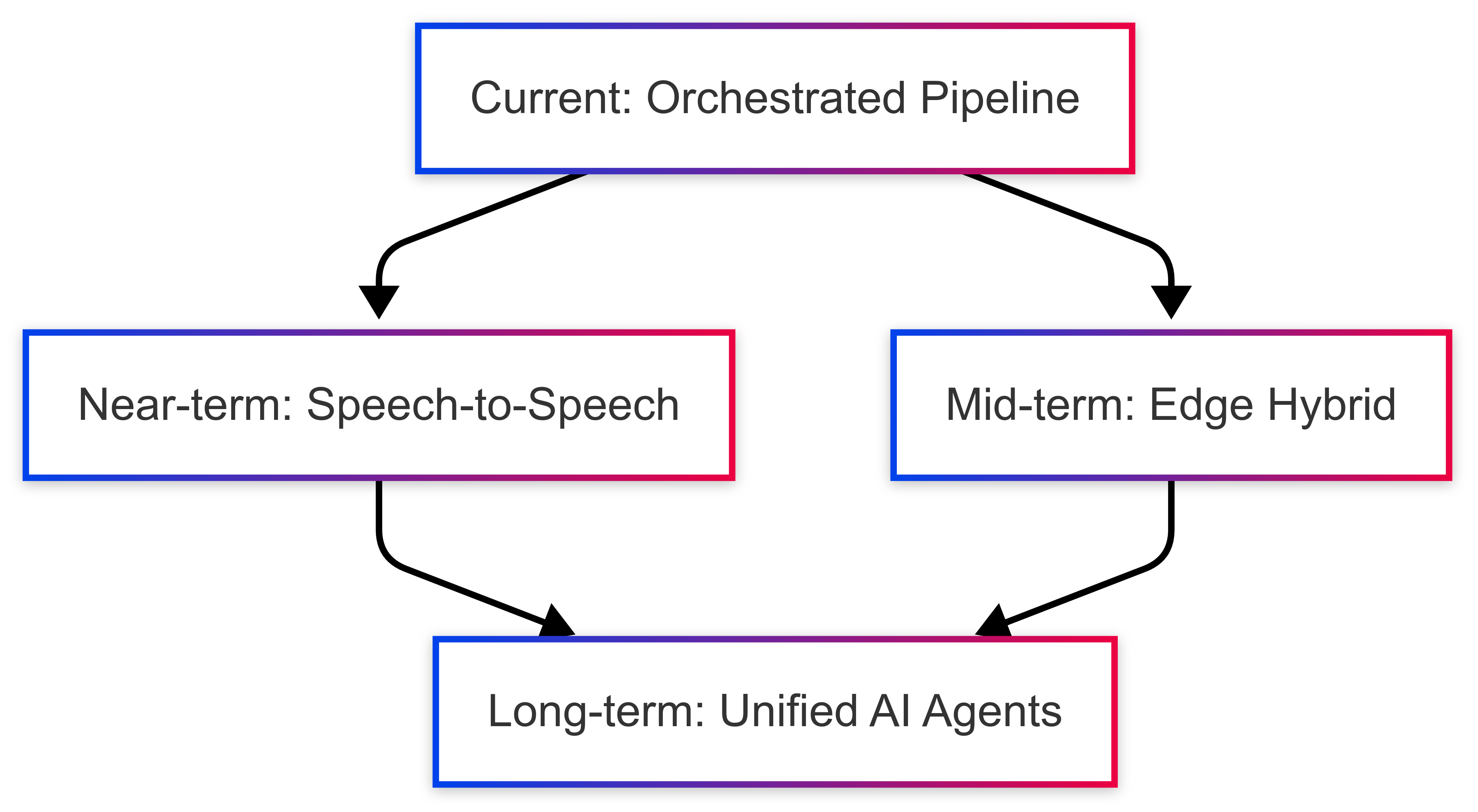
Architecture Choices to Revisit
Emerging Trends to Monitor
- Speech-to-Speech Models: OpenAI's Realtime API and similar systems are already available
- Revisit when: the provider's supported regions, modalities, controls, data terms, and billing model meet your requirements
- Cost impact: unified audio-token billing is different from a pipeline; do not assume it eliminates cost
- Edge AI Acceleration:
- Revisit when: target hardware can sustain the required model, concurrency, quality, and update process
- Cost impact: compare device/operations cost and utilization with managed inference
- Unified Voice Platforms:
- Current state: orchestration platforms such as Vapi and Retell are available
- Trade-off: simpler integration can add platform fees, limits, or lock-in; compare the complete invoice and operational burden
Architecture Evolution Path
Conclusion
Building cost-effective voice AI in production requires balancing quality, latency, cost, reliability, and scalability. The durable implementation principles are:
- Context management is critical: Implement early and aggressively
- Provider diversity reduces risk: Don't rely on single vendors
- Commercial terms matter: compare public list prices with the complete terms of any negotiated quote
- Architecture flexibility pays off: Design for component swapping
- Monitor everything: Token usage, latency, error rates, costs
No single per-minute cost or latency figure represents the market. Both depend on provider mode, speech share, context policy, billing increments, regions, network path, and reliability requirements. Recalculate from source-linked rates and benchmark the complete path whenever a model, SDK, or workload changes.
Pricing/model status in the selection tables and worked scenarios was checked on 22 July 2026. Historical performance figures remain labeled as such and must be revalidated for your workload.
The Voice Agent Pricing Calculator provides a reproducible cost scenario for a selected pipeline. It does not score quality or guarantee latency; pair the estimate with workload testing and provider quotes.
Try the scenario calculator at CompareVoiceAI.com.