In the rapidly evolving landscape of voice AI, selecting the right Large Language Model (LLM) provider forms the cornerstone of building effective, responsive voice agents. As voice AI deployments expand across industries—from healthcare and customer support to entertainment and personal assistance—understanding the key factors that influence LLM selection becomes critical for developers and product managers.
This guide will help you navigate the complex decision-making process of choosing an LLM provider specifically optimized for voice AI applications, with a deep dive into performance metrics, cost considerations, and architectural tradeoffs.
Pricing check (22 July 2026): Prices below are standard synchronous API list prices for the named host and model. Cache, batch/flex/priority, geography, long-context tiers, and temporary rates are separate. TTFT, throughput, and benchmark indexes later in the article are a May 2025 snapshot, not current guarantees.
The Voice AI Pipeline: Why LLMs Matter
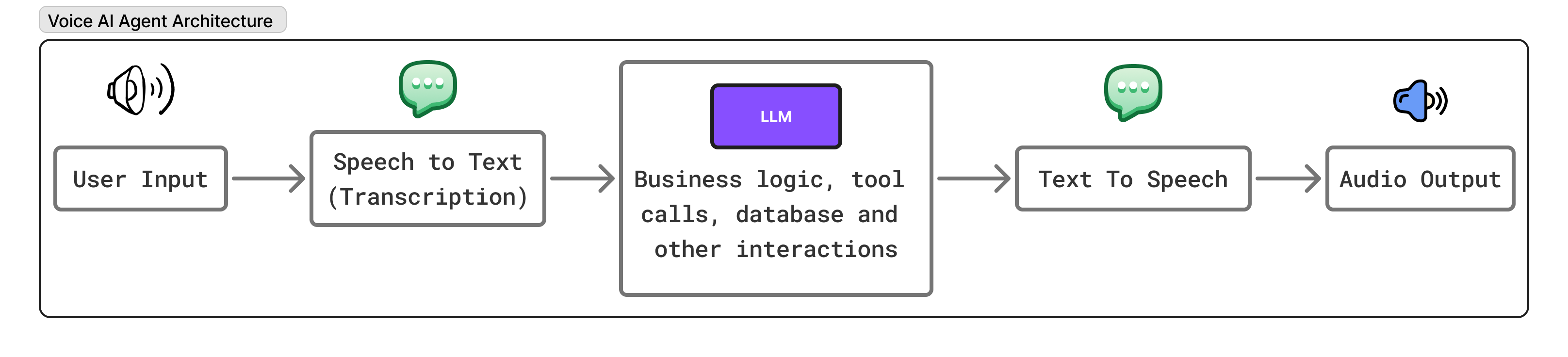
Voice AI agents orchestrate a complex pipeline where multiple AI models work together:
- Speech-to-Text (STT): Captures and transcribes user speech
- Large Language Model (LLM): Processes the transcript, understands intent, and generates responses
- Text-to-Speech (TTS): Converts LLM responses to natural-sounding speech
At the heart of this pipeline is the LLM—the "brain" that must understand the query and formulate a response. While all components matter, the LLM bears the highest cognitive load, determining the agent's intelligence, personality, and functional capabilities.
The Challenge: Balancing Requirements
The demands on an LLM for real-time dialogue are substantially higher than for one-off queries. Voice agents need models that deliver:
- Fast time-to-first-token (TTFT)
- Sustained low latency for multi-turn conversations
- High-quality responses with minimal hallucination
- Reliable function calling for backend integration
- Natural conversational abilities with appropriate pacing
- Cost-effective operation at scale
Finding the right balance between these sometimes competing priorities is the key challenge in LLM selection.
| Pricing host | Current model | Input / output per 1M tokens | Important qualifier |
|---|---|---|---|
| OpenAI | GPT-5.6 Luna | $1 / $6 | Cached read $0.10/M; long prompts can trigger multipliers |
| OpenAI | GPT-5.6 Terra | $2.50 / $15 | Cached read $0.25/M |
| Google Gemini API | Gemini 3.6 Flash | $1.50 / $7.50 | Output includes thinking tokens |
| Anthropic API | Claude Sonnet 5 | $2 / $10 through 31 Aug 2026 | Becomes $3 / $15 on 1 Sep 2026 |
| Anthropic API | Claude Haiku 4.5 | $1 / $5 | Cached read $0.10/M |
| DeepSeek API | DeepSeek V4 Flash | $0.14 / $0.28 | Cache-miss input baseline |
| Mistral API | Mistral Small 4 | $0.15 / $0.60 | Cached input and batch discounts are separate |
| Amazon Bedrock | Nova 2 Lite, Global Standard | $0.30 / $2.50 | Region/profile changes price |
| xAI API | Grok 4.5 | $2 / $6 | Up to 200K prompt; long-context tier is higher |
Meta/Llama is omitted because Meta does not publish one universal inference tariff; a valid row must name the exact hosting provider, model ID, region, and tier.
Key Metrics for Evaluating LLMs in Voice Applications
Latency Metrics
Historical benchmark note: The latency and throughput figures in this section were collected in May 2025 for then-current models. They are preserved for historical context and should not be compared directly with the current pricing table above.
Latency affects turn-taking, but its acceptable value depends on task, language, channel, and users. Separate model time to first token from the full end-of-speech to audible-response measurement.
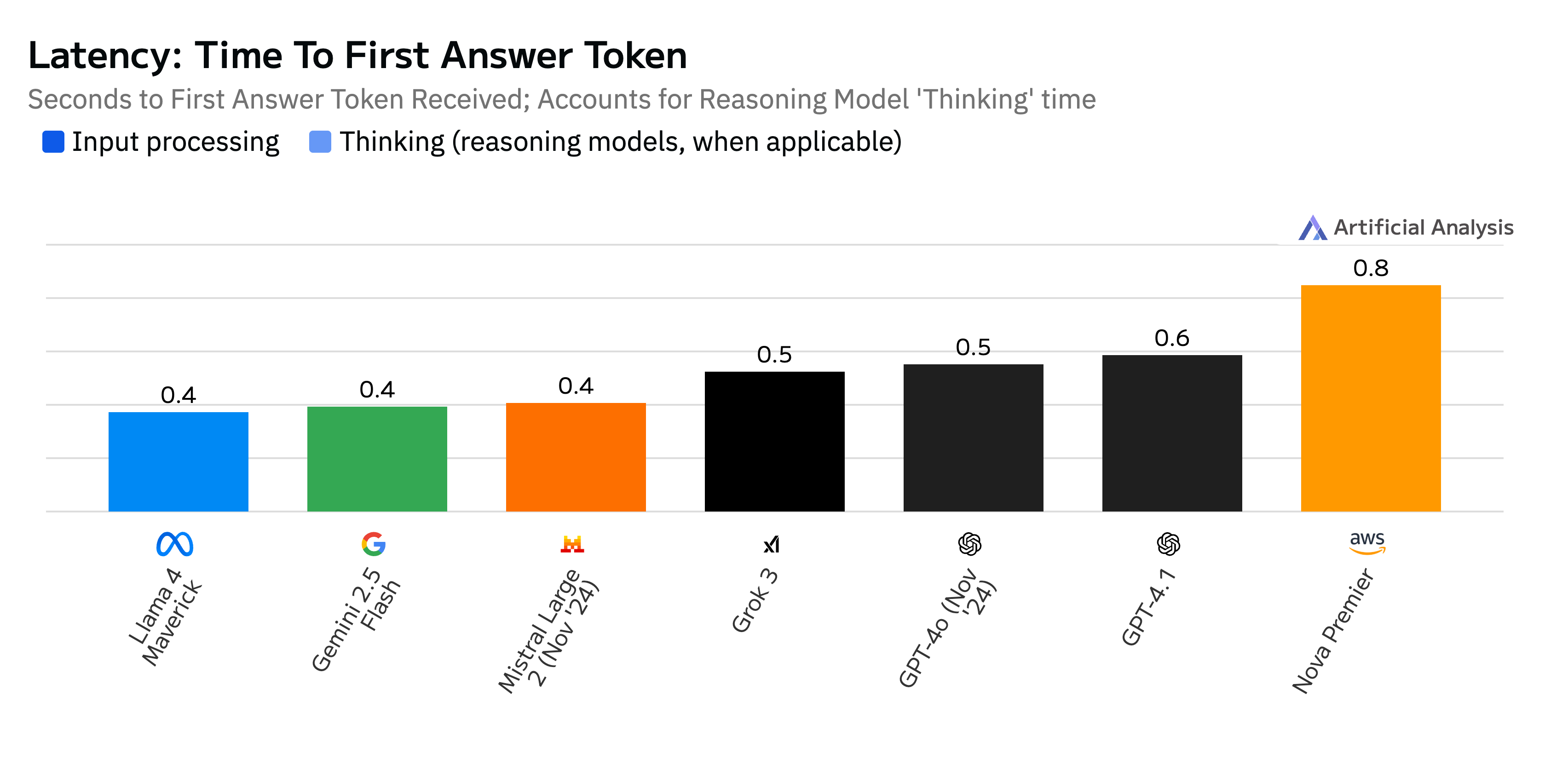
Time to First Token (TTFT): The May 2025 chart records historical measurements for then-current endpoints. Current values depend on model, prompt, region, tier, and load. Streaming can expose output before a response is complete; benchmark TTFT at useful percentiles and avoid truncating required context merely to hit an arbitrary threshold.
Output speed (throughput): Generation must sustain the response and TTS chunking strategy without starving playback. The values in the historical chart should not be transferred to current models or serving tiers. Measure the exact endpoint with representative prompt lengths and concurrency.
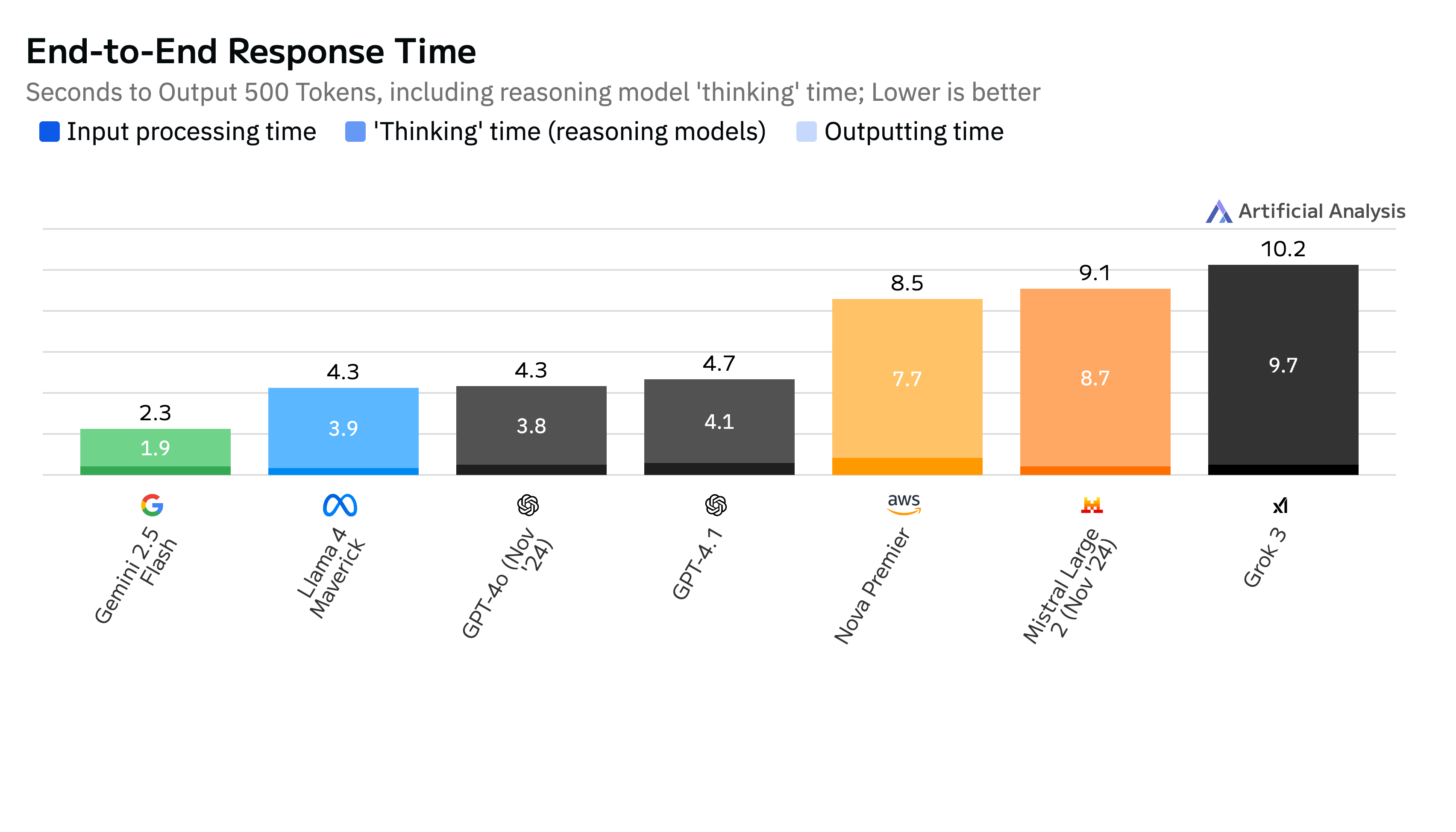
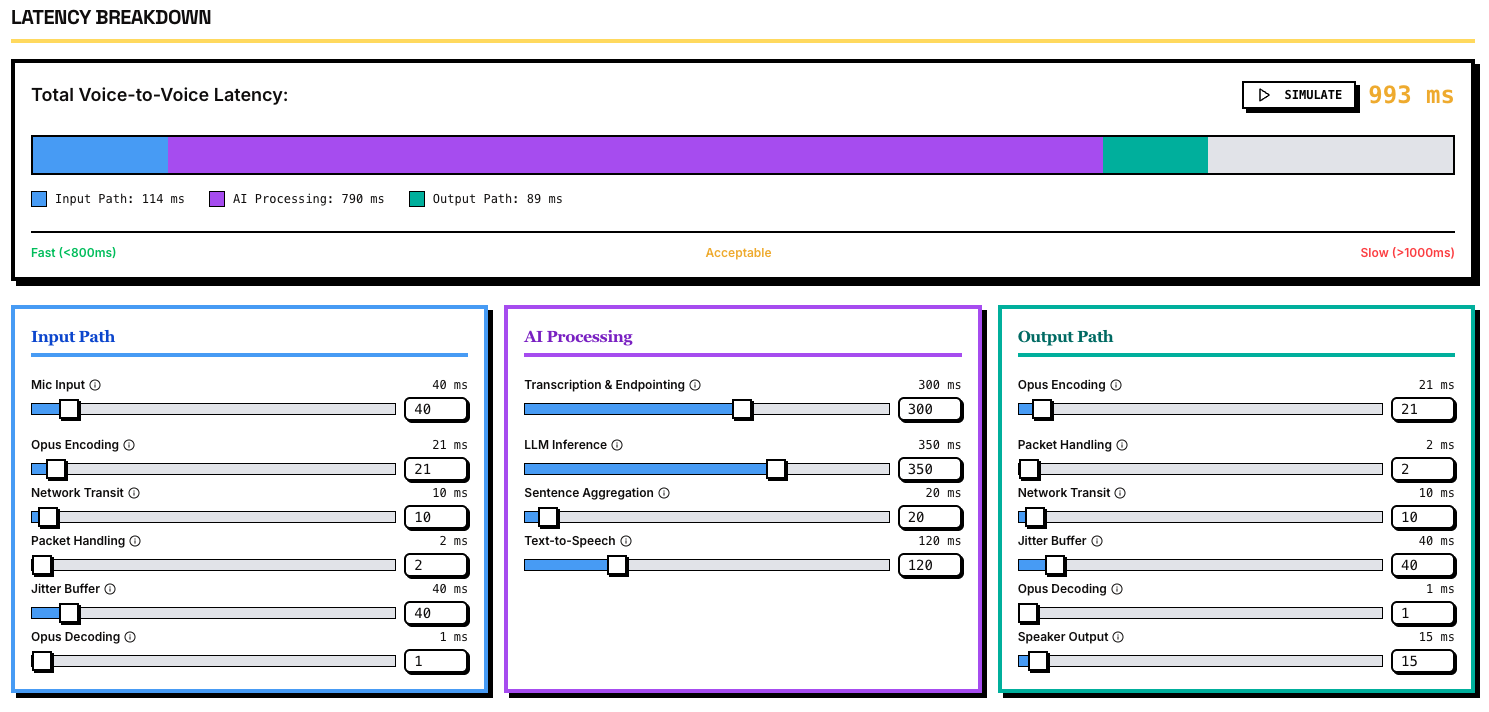
End-to-end latency: This is the time from the end of user speech to the beginning of audible agent speech. The following May 2025 budget is illustrative, not typical or prescriptive:
| Stage | Time (ms) |
|---|---|
| Audio Input Processing | ~114 |
| STT and Endpointing | ~300 |
| LLM TTFT | ~350 |
| TTS TTFT | ~120 |
| Audio Output Processing | ~89 |
| Total | ~973ms |
You can explore a timing scenario at comparevoiceai.com and then replace the inputs with measurements from your own stack.
Intelligence and Capability
Intelligence metrics help you understand how well an LLM can handle complex tasks and reasoning. The Artificial Analysis Intelligence Index combines multiple benchmarks to provide a unified score:
| Model | Intelligence Index | Coding Index | Math Index |
|---|---|---|---|
| GPT-4o-mini (high) | 70 | 63 | 96 |
| Gemini 2.5 Pro | 69 | 59 | 96 |
| Grok 3 mini Reasoning (high) | 67 | 55 | 95 |
| Claude 3.7 Sonnet Thinking | 57 | 44 | 72 |
| Llama 4 Maverick | 51 | 36 | 64 |
| GPT-4o (Nov '24) | 41 | 32 | 45 |
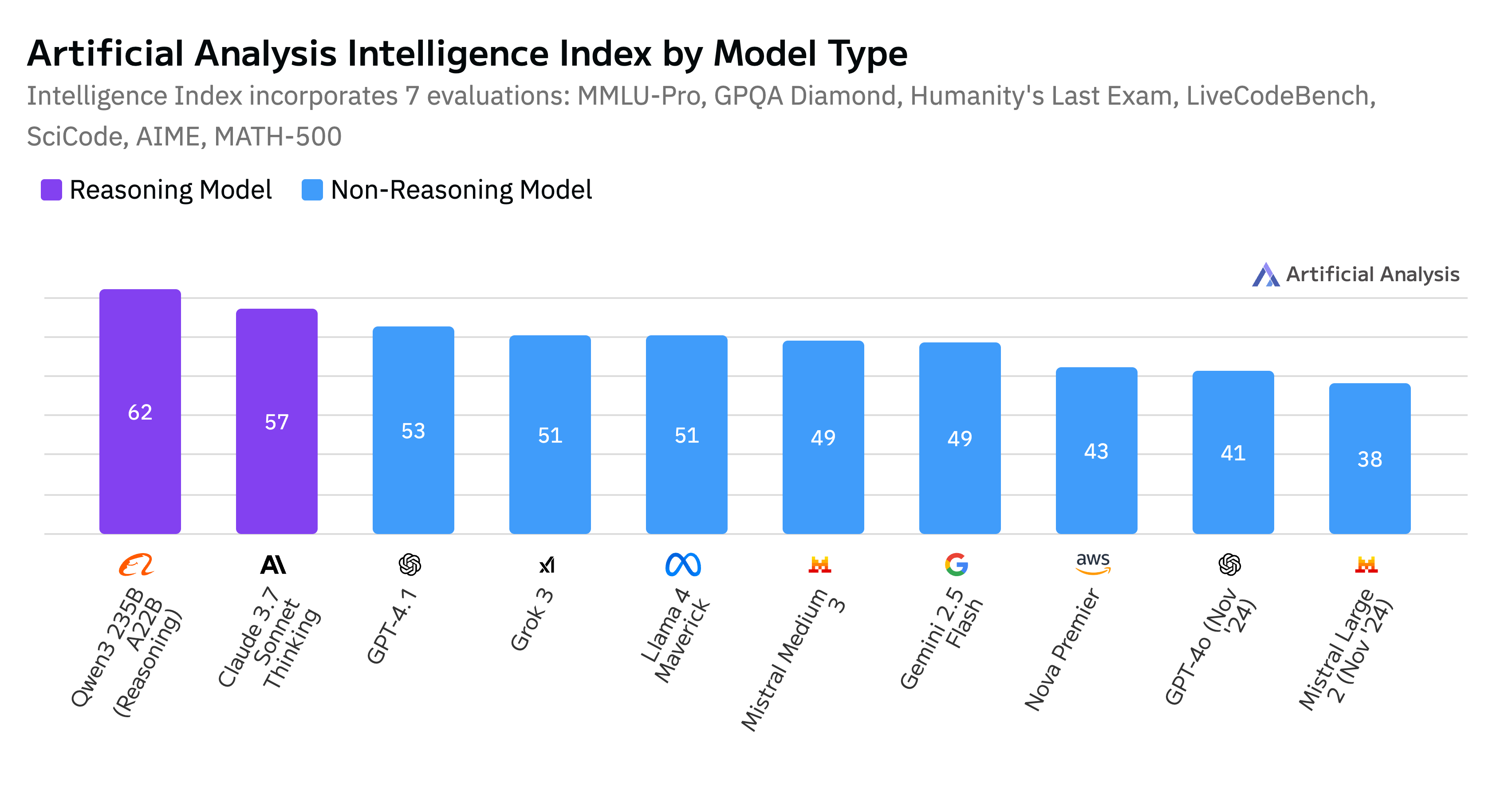
Conversational coherence: Evaluate active models with transcripts that test multi-turn references, corrections, ambiguous intent, brevity, and recovery from tool or transcription errors. Family-level reputations and the May 2025 benchmark table do not establish current performance for your prompts. Give explicit response-length and speaking-style instructions, then score the outputs consistently.
Handling interrupts: Barge-in is primarily an orchestration feature. Detect user speech, stop playback, cancel generation when supported, record what the user actually heard, and decide whether the partial answer belongs in the next prompt. Test cancellation and context behavior on the exact text or realtime endpoint; do not assume a model family handles interruption automatically.
Tool-calling strength: A voice agent may need to invoke calendars, account systems, or other APIs. For each current model and endpoint, test schema adherence, argument accuracy, parallel calls, cancellation, retries, tool-result handling, and latency. Use structured tool interfaces where available; for self-hosted models, validate any parser or constrained decoder instead of relying on free-form intent text. Historical references to Bard or ChatGPT Plugins do not describe current tool support.
Context Window
Context limits are version- and endpoint-specific and can change independently of model-family names. Check the current provider documentation for the exact model ID, including any smaller output limit or long-context pricing threshold.
Do not convert tokens to a fixed number of characters or pages: the ratio changes with language, formatting, code, and tokenizer. A large advertised window is not “unlimited,” and filling it on every turn can increase both cost and latency. Keep structured task state, retain only relevant recent turns, and use summaries or retrieval when evaluation shows they preserve the information the task needs.
Cost Structure
LLM costs can dominate the total expense of running a voice agent. APIs commonly price input and output separately per 1M tokens:
| Model | Input Price (per 1M tokens) | Output Price (per 1M tokens) |
|---|---|---|
| GPT-5.6 Luna | $1.00 | $6.00 |
| Gemini 3.6 Flash | $1.50 | $7.50 |
| Claude Sonnet 5 | $2.00 | $10.00 through 31 Aug 2026 |
| DeepSeek V4 Flash | $0.14 | $0.28 |
If every request resends the full history, input cost can grow super-linearly with conversation length. Rolling windows, summarization, retrieval, and caching can produce very different results.
Cost for Long Conversations: Duration does not determine LLM cost. Count uncached input, cached input, cache writes, and output tokens separately for every call, and apply any long-context tier. A full-history implementation can bill the same earlier tokens repeatedly; summarization, retrieval, and rolling windows reduce that repetition. Use the current input/output table above rather than a blended dollars-per-million or dollars-per-minute shortcut.
Optimization Techniques for Voice AI Agents
Selecting the right LLM is just the first step. To build high-performing voice agents, you need to implement optimization techniques that maximize responsiveness while controlling costs.
Semantic Caching
Semantic caching stores previous queries and LLM answers so that semantically similar prompts can reuse results without requiring a full model call.
Unlike traditional key-value caching (which hits only on exact string matches), semantic caching uses embeddings to match queries by intent, not exact wording. For example, "What's the weather in NYC?" and "How's the weather in New York City today?" have the same intent; a semantic cache would recognize their similarity and return a cached answer if available.
Implementation:
The system first converts an incoming prompt into a vector embedding that captures its meaning. It then performs a similarity search in a vector database (e.g., FAISS, Pinecone, Milvus) of past query embeddings. If a cached query with high cosine similarity is found above a threshold, the system returns the stored answer instead of calling the LLM.
# Pseudocode for semantic caching
def query_with_semantic_cache(user_query, similarity_threshold=0.85):
    # Convert query to vector embedding
    query_embedding = embed_text(user_query)

    # Search for similar queries in cache
    similar_queries = vector_db.search(query_embedding, top_k=5)

    # Check if any past query is similar enough
    for past_query, similarity in similar_queries:
        if similarity > similarity_threshold:
            # Cache hit - return stored answer
            return cache.get(past_query)

    # Cache miss - call LLM and store result
    answer = llm.generate(user_query)
    cache.store(user_query, query_embedding, answer)
    return answer
A cache hit can avoid model generation, but latency and hit rate depend on the embedding, index, threshold, network, validation policy, and query distribution. Measure lookup time, false-hit rate, and task quality on your traffic instead of assuming a 20-30% hit rate or a fixed response time.
For voice AI specifically, you can also cache generated TTS audio along with the text responses. On a cache hit, you can skip both the LLM and TTS steps, serving the pre-synthesized audio immediately.
Context Management and Summarization
As conversations grow longer, the context window fills up with dialogue history. This increases token count, raises costs, and potentially degrades LLM response quality and latency. Several techniques can mitigate this:
1. Rolling Context Windows
Instead of sending the entire conversation history each turn, keep only the last N turns verbatim and summarize older turns. This creates a sliding window that "forgets" distant history except for a synopsis.
# Pseudocode for rolling context window
def prepare_conversation_context(messages, max_recent_turns=5):
    if len(messages) <= max_recent_turns:
        return messages

    # Summarize older conversation turns
    older_messages = messages[:-max_recent_turns]
    summary = llm.summarize(older_messages)

    # Create new context with summary and recent messages
    new_context = [
        {"role": "system", "content": f"Previous conversation summary: {summary}"}
    ] + messages[-max_recent_turns:]

    return new_context
2. Memory Compaction
When conversations get very long, periodically inject a "summary memory" back into the prompt and clear out raw dialogue. For example, after 10 turns, insert: "Summary: [brief summary of discussion so far]" as a system or assistant message, then start a fresh context window with that summary plus the last Q&A.
3. Dynamic Prompt Trimming
In real time, decide what context to include based on relevance to the current query. For instance, if a user's new query is on a new topic, drop irrelevant past context altogether. If the user references something from earlier, retrieve just that piece.
This can be implemented with a retrieval-augmented approach: maintain a vector index of the conversation history and fetch only the portions semantically related to the latest query.
Streaming and Pipeline Parallelization
Traditional voice agents operated in a strictly turn-based fashion: the user speaks, the system waits for them to finish, then processes the query, and finally speaks the response. This results in noticeable dead air while the user waits for the agent's reply.
Modern real-time architectures instead use streaming at each stage, overlapping tasks to eliminate idle gaps:
1. Streaming STT
Rather than buffering the entire user utterance, streaming speech-to-text transcribes audio on the fly. As the user speaks, partial text hypotheses are produced every few hundred milliseconds.
2. LLM Token Streaming
Many current LLM services support streaming output, meaning tokens arrive incrementally. Verify support for the exact endpoint; time to first token matters, but the user still experiences endpointing, network, TTS buffering, and playback delays.
3. Early TTS Triggering
Streaming text-to-speech starts synthesizing audio from the first chunk of text and continues as more text comes in. This means as soon as the LLM produces a few words, the agent's voice can start speaking them.
The overlap of these components is crucial: if the model streams at 20 tokens/sec and the TTS can synthesize just as fast, the spoken output will closely trail the model's generation.
Here's a pseudocode implementation of a streaming pipeline:
# Pseudocode for a streaming voice AI pipeline
async def voice_conversation_loop():
    # Setup streaming connections
    audio_stream = setup_audio_stream()
    stt_stream = setup_stt_stream()
    llm_stream = setup_llm_stream()
    tts_stream = setup_tts_stream()

    # Start processing in parallel
    async for audio_chunk in audio_stream:
        # Process audio and get partial transcriptions
        stt_stream.process(audio_chunk)

        if stt_stream.has_new_text():
            partial_text = stt_stream.get_latest_text()

            # If user finished speaking (based on VAD)
            if stt_stream.is_utterance_complete():
                full_text = stt_stream.get_full_text()

                # Send to LLM and start getting streaming response
                llm_stream.send_prompt(full_text)

                # As LLM tokens arrive, send them to TTS in chunks
                async for llm_response_chunk in llm_stream:
                    tts_stream.synthesize(llm_response_chunk)

                    # As audio becomes available, play it
                    if tts_stream.has_audio():
                        audio_chunk = tts_stream.get_audio()
                        audio_stream.play(audio_chunk)
Pipelining removes avoidable idle time, but it does not guarantee a 600 ms result. Measure the full path with current providers, realistic prompts, and network conditions, including rollback when an interim transcript changes.
Interruption Handling
Human conversations are messy – people interrupt each other, change their minds mid-sentence, or speak at the same time. For a voice AI agent to feel natural, it must handle interruptions gracefully.
The key components for effective interruption handling are:
- Barge-in detection: Using an always-on voice activity detector (VAD) to detect when the user starts speaking while the agent is talking
- Immediate TTS cut-off: Stopping the audio output instantly when an interruption is detected
- LLM adjustment: Properly handling the partial response in the conversation context
For LLM context management after an interruption, one approach is to discard or roll back the last LLM response if it was interrupted. In terms of chat history, you might not include the incomplete answer in the context for the next LLM call. Instead, treat the user's interruption as the next turn and generate a fresh response.
Future-Proofing Your Choice
LLM technology is evolving rapidly, with performance improvements and price reductions happening regularly. To future-proof your decision:
- Build your architecture to be model-agnostic, with the ability to swap providers
- Use abstraction layers that can translate between different API formats
- Implement A/B testing capabilities to benchmark new models as they emerge
- Consider hybrid approaches that can leverage multiple models based on query type
By carefully evaluating these factors and implementing the optimization techniques described in this guide, you can build voice AI agents that provide responsive, natural, and cost-effective experiences for your users.
Looking to compare different voice AI platforms and components? Check out our interactive comparison tool to explore STT, LLM, and TTS cost combinations for your assumptions.