Voice AI agents can support customer service, personal-assistant, and business workflows. Their cost can rise quickly with usage and conversation history, so this guide focuses on measurable ways to optimize each component of the stack.
Pricing check (22 July 2026): Provider prices below use public list pricing and the stated billing mode. They exclude taxes, free tiers, commitments, add-ons, regional differences, request minimums, and token-cache effects unless noted. Performance scores in this article are a May 2025 benchmark snapshot and are not presented as current provider guarantees.
Understanding the Cost Structure
Before diving into optimization, let's understand what drives costs in a voice agent:
- Speech-to-Text (STT): Transcribing audio or billing an open streaming session, depending on provider mode
- LLM Processing: Charging input, cached input, and output tokens with possible context thresholds
- Text-to-Speech (TTS): Billing generated characters, audio or text tokens, runtime, or plan credits, depending on the product
- Infrastructure: Hosting orchestration, media transport, state, observability, and regional capacity; derive this from measured concurrency and resource use
If every LLM call resends the complete conversation history, the modeled input-token cost grows super-linearly with conversation length:
| Session Length | Approximate Relative Cost |
|---|---|
| 3 minutes | 1x |
| 10 minutes | ~10x |
| 30 minutes | ~100x |
This illustrative pattern is not inevitable: rolling context windows, summarization, retrieval, and prompt caching can materially change it.
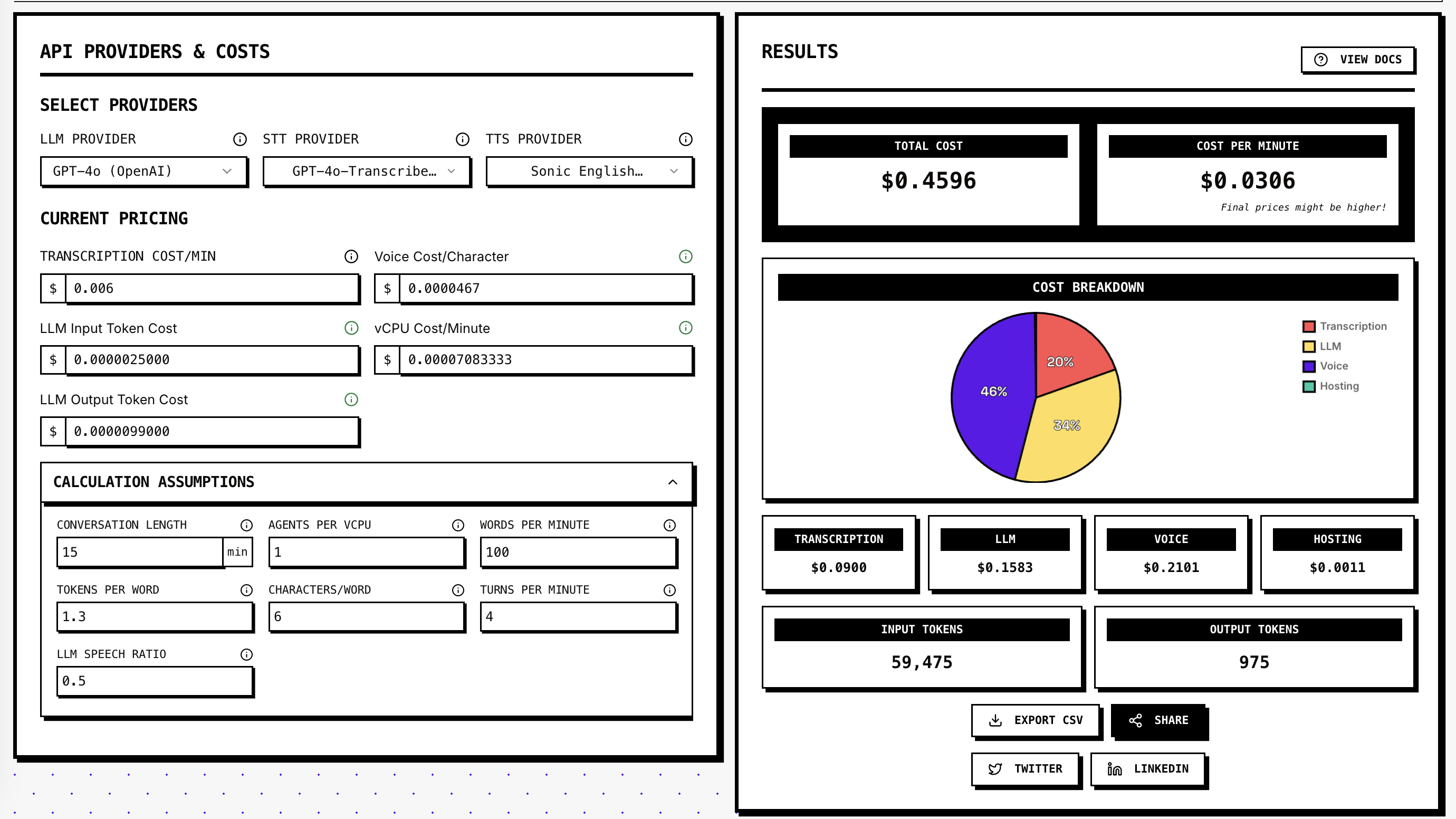
To visualize costs across providers, use CompareVoiceAI.com to compare voice AI model pricing under the same assumptions.
LLM Cost Optimization (The "Brain")
The LLM is often the most strategically important component to optimize:
1. Choose Cost-Effective Models
The difference between models can be dramatic:
- OpenAI GPT-5.6 Luna: $1 input / $6 output per 1M tokens
- Google Gemini 3.6 Flash: $1.50 input / $7.50 output per 1M tokens
- Anthropic Claude Sonnet 5: $2 input / $10 output per 1M tokens through 31 August 2026, then $3 / $15
Conversation cost cannot be inferred from duration alone; calculate input and output tokens separately and include cache and long-context tiers where applicable.
2. Implement Context Management
Context management is critical for long conversations:
# Example: Summarizing context after X turns
if turn_count % 5 == 0:
    summarization_prompt = f"Summarize this conversation concisely: {full_context}"
    summary = llm.generate(summarization_prompt)
    context = f"Previous conversation summary: {summary}\n\nRecent exchanges:\n{recent_turns}"
Technical approaches:
- Rolling window: Keep only the last N exchanges in full detail
- Summarization: Periodically summarize older parts of the conversation
- Vector embeddings: Store conversation turns as embeddings and retrieve only relevant ones
- State tracking: Maintain explicit state variables rather than full conversation history
3. Utilize Token Caching
Caching can reduce repeated processing, but eligibility and billing differ by provider, model, endpoint, prefix length, and retention period. Some products cache qualifying prompt prefixes automatically; others require explicit cache creation and may separately charge for writes, reads, or storage.
For repetitive scenarios such as verification flows or FAQs, calculate savings from the measured hit rate and the current model's documented cache-read, cache-write, and storage terms. Do not assume a cache rule from one model applies to another or to a realtime endpoint.
4. Optimize Prompt Design
- Keep system instructions as concise as the task and safety requirements allow
- Use concise function definitions
- Structure your conversation format efficiently
STT Cost Optimization (The "Ears")
Speech-to-text costs are generally linear but can still be optimized:
1. Provider Selection
Compare leading providers:
| Provider | Current list-price basis | Historical WER snapshot |
|---|---|---|
| Whisper Large v3 Turbo, Groq | $0.0006667/min (10-second minimum) | 12.0% |
| GPT-4o Mini Transcribe | Token-billed; no fixed per-minute list price | 13.2% |
| Deepgram Nova-3 | $0.0077/min, monolingual pre-recorded PAYG | 12.8% |
| Whisper-1, OpenAI | $0.006/min | 10.6% |
| Google Chirp 3 | $0.016/min, V2 Standard first tier | Not benchmarked in the May 2025 table |
2. Batching and Processing Strategies
- Partial processing: For non-critical portions of conversations, use faster/cheaper models
- Offline processing: For asynchronous use cases, use batch processing when possible
- Endpointing optimization: Fine-tune voice activity detection to avoid processing silence
3. Self-Hosting Considerations
At sufficient and predictable utilization, self-hosting open-source models may be worth evaluating:
- Whisper can be deployed on your own infrastructure
- Faster-Whisper offers optimized inference
Calculate the break-even point from your own benchmark: compare managed cost for the exact mode and volume with accelerators, idle capacity, redundancy, storage, networking, monitoring, upgrades, and engineering support. A GPU-only estimate is not a complete self-hosting cost.
TTS Cost Optimization (The "Voice")
Text-to-speech can often be the most expensive component on a per-minute basis:
1. Provider Selection
| Provider | Cost per 1M chars | Quality Score |
|---|---|---|
| Kokoro 82M, Replicate | Runtime-priced; no fixed character rate | 1089 |
| Azure Neural | $15.00 | 1059 |
| TTS-1, OpenAI | $15.00 | 1135 |
| Sonic 3.5, Cartesia | $50.00 effective on Pro; plan-derived | Historical Sonic English score: 1106 |
| Flash v2.5, ElevenLabs | $50.00 | 1107 |
| Multilingual v2, ElevenLabs | $100.00 | 1116 |
The quality-to-cost ratio is workload- and listener-dependent. Use the price table to create a shortlist, then test the exact voices, languages, audio format, and latency path your application will use.
2. Voice Selection and Compression
- Choose standard voices over premium ones when quality isn't critical
- Test audio compression such as Opus at the bitrates your channel supports; intelligibility and quality requirements determine the floor
- For narrowband telephony, 8 kHz may match the channel, while wideband applications should preserve a higher sample rate
3. Caching and Pre-generation
- Cache common responses (greetings, confirmations, etc.)
- Pre-generate script segments for frequently used phrases
# Example TTS caching system
import hashlib


tts_cache = {}
def get_speech(text, voice_id):
    cache_key = f"{voice_id}:{hashlib.md5(text.encode()).hexdigest()}"
    if cache_key in tts_cache:
        return tts_cache[cache_key]

    audio = tts_provider.generate(text, voice_id)
    tts_cache[cache_key] = audio
    return audio
System-Level Optimizations
Beyond individual components, consider these holistic approaches:
1. Multi-Model Orchestration
Use different models for different stages of conversation:
def process_user_input(text, conversation_state):
    if is_simple_query(text):
        # Use cheaper model for simple queries
        return cheaper_llm.generate(text, conversation_state)
    else:
        # Use premium model for complex reasoning
        return premium_llm.generate(text, conversation_state)
2. Conversation Design for Efficiency
- Design conversations to achieve goals in fewer turns
- Implement guided flows for common scenarios rather than open-ended chat
- Segment long conversations into multiple shorter sessions
3. Infrastructure Optimization
- Benchmark safe concurrent agents per vCPU under realistic media, logging, and failure-recovery load
- Implement autoscaling to match demand patterns
- Co-locate components to reduce network latency and costs
Real-World Scenarios and Cost Analysis
Scenario 1: Customer Support Voice Agent (10-minute calls)
Example fixed-unit stack:
- STT: Whisper-1 ($0.006/audio minute)
- LLM: OpenAI GPT-5.6 Luna ($1 input / $6 output per 1M tokens)
- TTS: ElevenLabs Flash v2.5 ($0.05/1,000 characters)
Alternative stack:
- STT: Deepgram Nova-3 ($0.0077/min, monolingual pre-recorded PAYG)
- LLM: Gemini 3.6 Flash ($1.50 input / $7.50 output per 1M tokens)
- TTS: Amazon Polly Neural ($16/1M characters)
Use actual input/output tokens and generated characters to compare these stacks; a universal per-minute total would be misleading.
Scenario 2: Long-duration Personal Assistant (30+ minute sessions)
Without context management, a long session can become disproportionately expensive because earlier turns may be billed repeatedly.
With optimization:
- Implement rolling 5-turn context window with summarization
- Use token caching for repetitive patterns
- Compare lower-cost candidates in the current LLM API pricing table and route only the tasks that meet your quality target; Gemini 3.6 Flash is not cheaper than GPT-5.6 Luna in this snapshot
- Measure savings against the same workload and quality target
Future Trends in Cost Optimization
- Native Speech-to-Speech Models: End-to-end audio changes the billing units and orchestration path; compare the current total cost and controls with a pipeline rather than assuming it is cheaper
- On-device Processing: Edge deployment of smaller models for certain components
- Multimodal Compression: Better techniques for compressing audio in context
Conclusion
Cost optimization for voice AI agents requires a multi-layered approach targeting each component while considering the entire system. The most impactful strategies are:
- Choose cost-effective models for your use case
- Implement robust context management for long conversations
- Utilize token caching where available
- Select the right providers for your quality/cost requirements
- Design conversation flows to minimize turns and context growth
By applying these strategies and measuring real token, audio, and character usage, you can reduce cost without relying on a misleading universal per-minute promise.
Compare model pricing and explore latency assumptions on CompareVoiceAI.com, then validate the shortlist with your own traffic and quality tests.